
Can a software package really help you ‘unlock growth’? Can you just flick a switch and see your revenue climb?
While it takes a lot to translate code into cash, I certainly agree that slow, rigid, restrictive software can hinder a business’ growth.
“Unlocking growth” was the theme of Oracle Netsuite’s SuiteConnect conference in Sydney last week. The ERP company explained how it builds its software around three business concepts that are essential to growth; Visibility, Control and Agility.
It’s great to see a software vendor attempting to draw direct lines between software functionality and business outcomes in very specific terms. Paul Farrell, VP Product Marketing at Oracle Netsuite, described how the software interpreted these three concepts.
Visibility is different to reporting. Most systems these days come with a basic dashboard, a set of reports and sometimes alerts and notifications.
The next level is to identify blind spots in your business, and to show relevant insights during everyday activity.
For example, when you are updating a project budget, you should see the effect it might have on project profitability right away. You don’t want to wait until after the project has finished and you are looking at your job analysis.
Or when you are recording a customer order, you see relevant margins and stats on similar orders or similar clients (will they pay on time?).
Blind spots will usually be in areas that are harder to track or report on. Things like creeping costs and increased discounting, as well as employee churn and the cost of recruiting and training up new staff, Farrell said.
Businesses often run deals with shipping included and forget to re-assess when shipping costs go up. Or they run out of a product through a large number of small, online sales and then are unable to fulfil big, wholesale orders.
There are two aspects to removing blind spots: capturing the data and analysing it. And if it cannot be captured pretty much hands-free, it is unlikely to ever be reportable.
Two important advantages of a good ERP system are that it captures all data in a single database, and the strength of report building tools.
Every business has destabilising and distracting factors. These are disruptive events that we must respond to quite quickly, but we never know when they are going to occur.
The current, very palpable distraction is the Wuhan-born Coronavirus. It is affecting the supply chain of many businesses that manufacture in China, or rely on products or components from that region.
More common business distractions include audits, regulatory changes and unfortunate product shortage due to theft, human error, and fire and flood.
Greater control makes it more likely that you will become aware of these issues sooner. It also means you are likely to have mechanisms in place to deal with them efficiently on the fly.
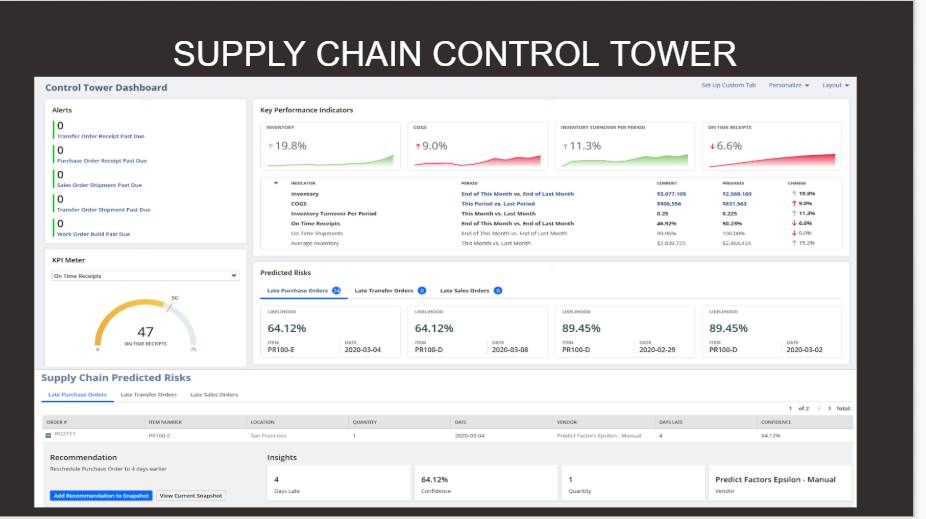
Farrell demonstrated the impressive-looking Supply Chain Control Tower. It uses machine learning and other types of AI to identify and predict delays in the supply chain based on activity. The Tower then suggests data-driven solutions to these issues.
For example, it can quickly identify that a certain supplier is getting slow on delivery, and suggest other suppliers to source comparable items or another location that has extra supply. It can then take further action and divert existing orders there.
The current Coronavirus crisis has put pressure on BioPak, an Australian provider of environmentally friendly packaging, which prides itself for never running out of stock.
BioPak CEO Gary Smith spoke about using controls in his software to quickly classify customers based on their order history. He then prioritised continuous supply to existing customers over flocks of ad hoc orders from competitors’ clients who were running low on stock.
With the advances of technology, businesses encounter inflection points that require the ability to pivot or to expand.
A business that once used to receive an order, fulfil it, then invoice, will now offer subscription-based services, and get an edge if they can bill according to usage, as tracked by sensors connected to the Internet of Things (IoT).
Adding these billing methods can be painful if your operational and financial packages do not offer these options. NetSuite is building a platform that can support new business models relatively easily, Farrell said.
I surprise myself by agreeing. We are used to thinking that small accounting packages are more agile and adapt faster to business needs. But in reality, neither Xero nor QuickBooks Online offer anything but transactional invoicing. There is no subscription-based or usage-based billing. Instead, they rely on third-party software to provide these functions and send the resulting invoices into the accounting system.
This often leaves the business with a multitude of systems that have a compartmentalised view of their customer. And we are all too familiar with the complications of modifying, deleting or merging an invoice with another when using separate software for accounting and invoicing. All the customer wants is a single invoice for more than one service.
It’s a refreshing idea to decide on the keys for growth and develop software accordingly. Let’s see whether these features will actually make businesses more aware, more agile and have greater control.
This article was written by Inbal Rodnay. For AI talks and workshops visit Inbal.com.au
Disclosure: Inbal Rodnay Steinberg travelled to Sydney as a guest of Oracle NetSuite.
Image credit: NetSuite
Interviews, registers and essays. Free.

Make your agents work.

